Never Chase Timesheet Errors Again: Auto-Generated Timesheets
04 Jun 2026
04 Jun 2026 by Luke Puplett - Founder

It's Friday 5pm. Your contractors' timesheets are trickling in. One's missing two days. Another has hours that don't add up. A third billed 40 hours but only worked 35. Now you're sending correction requests, waiting for responses, chasing them down again, and watching margin disappear while you manage admin.
This is the timesheet problem most agencies live with. And it doesn't have to be this way.
The Real Cost of Manual Timesheets
When you ask someone to fill in a timesheet, you're asking them to remember. And human memory is terrible at it. They're scrolling back through emails trying to piece together Tuesday afternoon. Did they work 3 hours on that feature or 2.5? Does the meeting count as billable? They guess. You dispute it. You both spend two weeks arguing over £400.
The hidden cost isn't just the back-and-forth. It's:
Delayed payments while you correct errors
Lost contractor goodwill when they feel nickel-and-dimed
Inaccurate client invoices because timesheet data doesn't match reality
Admin overhead that scales with your business—more contractors means more corrections
Margin erosion from disputes and billing inaccuracies
But here's the thing: the error isn't the contractor's fault. It's not a memory problem. It's a system problem. You're asking them to manually transform their work into billing units. That's where errors happen.
The Better Way: Separate Tracking from Billing
What if contractors didn't have to fill in timesheets at all?
What if they just tracked what they actually did—as they did it—and the system automatically generated their timesheet?
That's exactly what Zipwire does. And it's why timesheets built this way are almost never wrong.
The secret is keeping time journalling and timesheeting completely separate.
How It Actually Works
The flow is beautifully simple:
-
Contractors track time privately in their journal. Granular, detailed, for their eyes only. "2h 30m on the checkout feature. Fixed the payment timeout bug. Client: Acme Corp. Location: Remote." That's reality, captured in real time. No forms. No guesswork.
-
You configure billing rules once. How do they bill? 8-hour days? Half-days? Hourly with overtime tiers? Different rates for weekends? You set this up in your workflow. Rules can even change mid-period if someone moves to a new contract.
-
The system maps their journal to billing units. When it's time to get paid, Zipwire takes their granular journal data and transforms it using your billing rules. The system handles all the maths. Hours to billing units. Rate tiers. Activity aggregation. Everything.
-
The timesheet is generated, not filled in. The result: a clean, correct timesheet showing what was billed and why. Your contractors see their own journal (private). You see the timesheet (transparent). Everyone trusts the numbers.
The timesheet isn't filled in by a human trying to remember. It's generated from data captured in real time, transformed by rules you control.
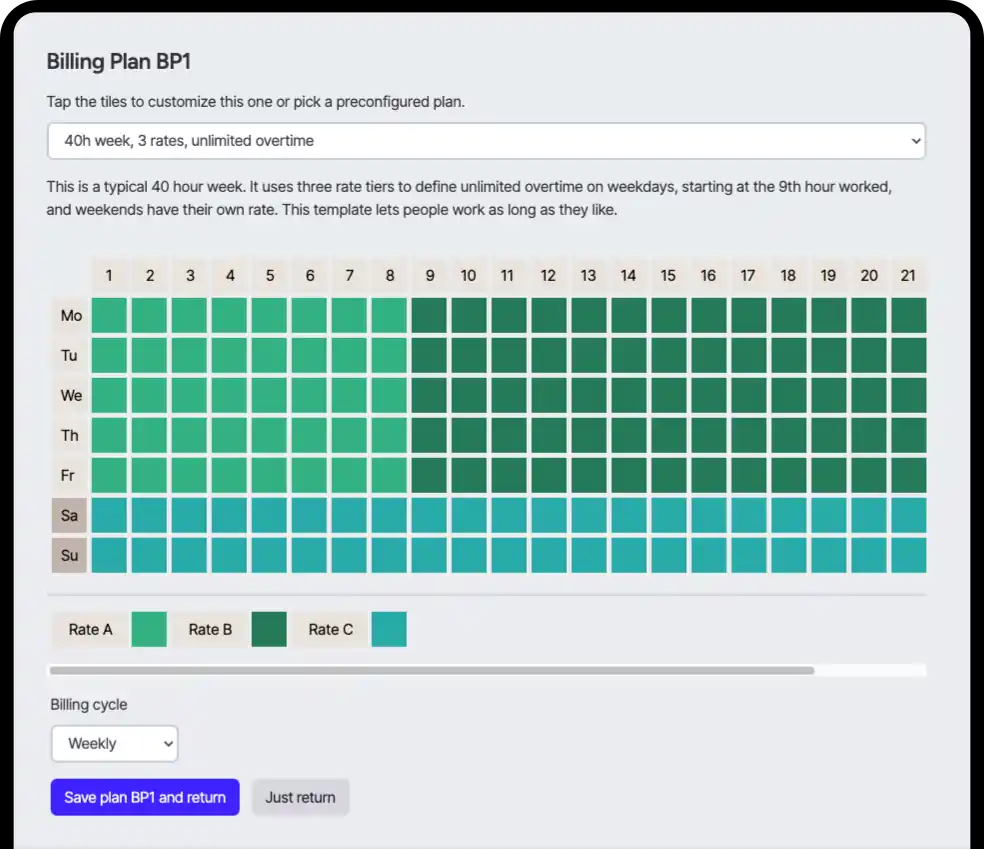
Your billing rules are configured once. The system handles the rest—even when rules are complex.
Real-World Scenarios
For Agencies: Stop Chasing Corrections
You manage 20 contractors across 15 clients. Every week brings the same chaos:
Contractor submits wrong hours
You send a correction request
You wait for a response
You chase them down again
You fix it, re-invoice, deal with payment delays
It's death by a thousand cuts.
With auto-generated timesheets, this vanishes. Your contractors track time as they work. At the end of the week, their timesheet is complete and correct. No corrections needed. No chasing. No excuses.
From your side:
No corrections needed. Timesheets are generated from accurate data, not filled in by hand. No back-and-forth. No "can you clarify Tuesday?"
Zero reconciliation. The timesheet is built from the contractor's private journal using your billing rules. What you see is what you get. No discrepancies to hunt down.
Holiday detection built in. The system knows about holidays and handles them automatically. No manual adjustments. No missed bank holidays.
Confidence in the numbers. Every timesheet is generated from timestamped journal data and auditable billing rules. If a client disputes it, you've got proof.
Scale without scaling admin. 20 contractors or 200, the system handles it. Your chasing time stays flat.
For Contractors: Peace of Mind
You're juggling three clients. It's Friday and your timesheet is due Monday. You're scrolling back through Slack trying to remember if that meeting was 1 hour or 1.5 hours. You guess. Client disputes it. Now you're in an email thread for two weeks.
With Zipwire:
Your timesheet is already done. You didn't wait until Friday. You logged time as you worked. The system generated your timesheet automatically.
It's always correct. Because it's built from data you captured in real time, not memory from three weeks ago.
No disputes. Your client can see exactly what you worked and why you billed what you billed. Transparent. Auditable.
Get paid faster. No back-and-forth corrections. No delays waiting for approvals.
The Math Behind Correctness
Why does this system almost never get it wrong?
Because errors happen at the intersection of memory and manual data entry. You remember something, you type it into a form, someone interprets what you typed. Each step is a chance to get it wrong.
Auto-generated timesheets eliminate that. The flow is:
Data capture: Time is logged in real time (no memory required)
Automatic transformation: Rules engine converts journals to billing units (no manual data entry)
Transparent output: Both journal and billing visible side-by-side (easy to audit)
The human is out of the error loop. The system handles the complexity.
Beyond Simple Hourly Billing
This gets even more powerful when billing gets complex. Imagine:
Different billing units (hourly on one contract, half-days on another)
Rate tiers (8 hours standard, then overtime rates, then weekend rates)
Rate changes mid-period (contractor moves to a new assignment with different terms)
Multi-client projects (one week across three different clients with different billing rules)
A contractor trying to manually fill in a timesheet with all this complexity? That's where serious errors happen. The Zipwire system handles it all automatically. Rules are rules. The system applies them consistently.
Getting Started
Setting up auto-generated timesheets takes three simple steps:
-
Define your activities. What types of work do your contractors do? Frontend work, meetings, DevOps, QA? Set them up once.
-
Create billing rules. For each assignment, define: unit type (hourly, half-day, etc.), rates, rate tiers, working days. This is where you encode your business logic.
-
Contractors start journaling. They track time against activities—however suits them. Send a quick WhatsApp voice note while on the go. Log it via CLI like a git commit if you're a developer using Zipwire CLI and Claude Code automation. Or just use the app. The system handles the rest.
That's it. From then on, timesheets are automatically generated from accurate data. No corrections. No disputes. No Friday night panics.
Want to see it in action? Send a WhatsApp message to +1 (949) 806-6089 to sign up and start using Zipwire.
The Money Part
Every hour of admin chasing timesheets costs you. Every disputed invoice delays payment. Every correction cycle eats margin.
Zipwire eliminates that. Your contractors still do their jobs. You just stop managing their mistakes.
The best agencies don't waste time on corrections. They waste zero time on corrections.
Beyond Timesheets: Verifiable Experience
Here's where it gets interesting. Once a timesheet is approved, the system doesn't just stop. It extracts the skills your contractors actually used—directly from the work they logged.
That React debugging session? That's React experience. That DevOps incident response? That's production incident management. The system sees it, categorizes it, and builds a verifiable record of real skills from real work.
These skills can be attested on the blockchain, creating a portable, cryptographically-signed proof of experience. Your contractors can share this with future employers or clients. No CV padding. No AI-generated fantasies. Just: here's the work I actually did, here's the proof.
Learn more about how skills are automatically extracted from timesheets.
That's lovely and everything but what is Zipwire?
Zipwire Collect handles document collection for KYC, KYB, AML, RTW and RTR compliance. Used by recruiters, agencies, landlords, accountants, solicitors and anyone needing to gather and verify ID documents.
Zipwire Approve manages contractor timesheets and payments for recruiters, agencies and people ops. Features WhatsApp time tracking, approval workflows and reporting to cut paperwork, not corners.
Zipwire Attest provides self-service identity verification with blockchain attestations for proof of personhood, proof of age, and selective disclosure of passport details and AML results.
For contractors & temps, Zipwire Approve handles time journalling via WhatsApp, and techies can even use the command line. It pings your boss for approval, reducing friction and speeding up payday. Imagine just speaking what you worked on into your phone or car, and a few days later, money arrives. We've done the first part and now we're working on instant pay.
All three solutions aim to streamline workflows and ensure compliance, making work life easier for all parties involved. It's free for small teams, and you pay only for what you use.